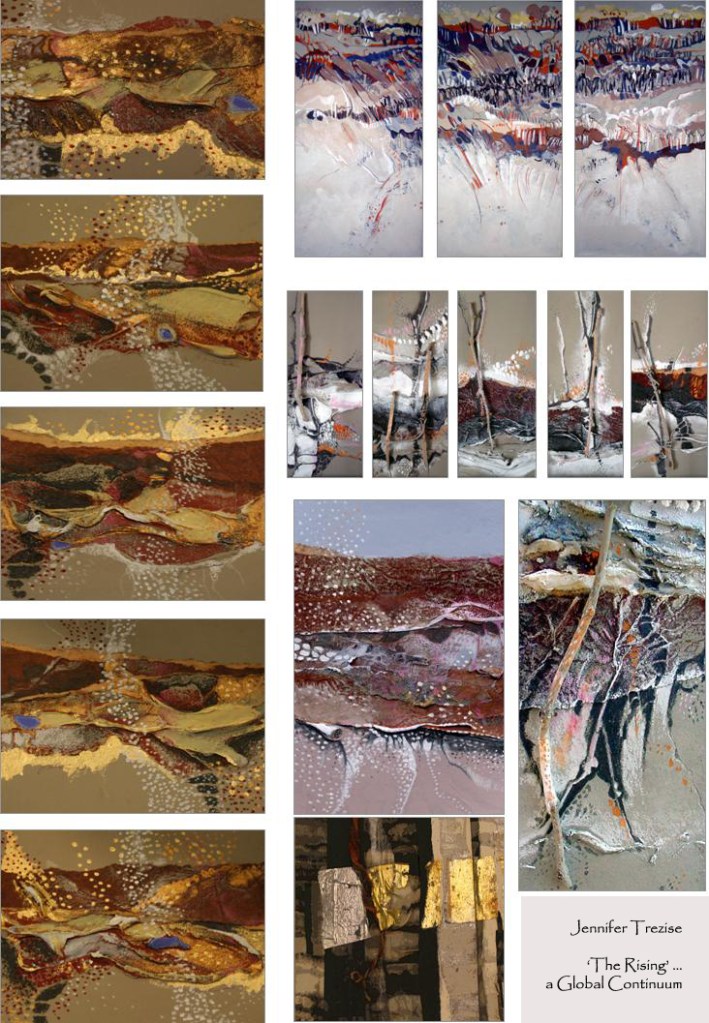
‘The Rising’ is a metaphor for rescuing, renewal and rebirth, through water and the new earth ‘terra nova’ is the vehicle of ‘The Rising’ continuum. This is a body of work in a global context…a journey which looks forward, but is mindful of past experiences and exhibitions.

My Work Plan for my Finnish Residency
Multiples
I use multiples or works in series to respond to my travels to Finland in 2001, 2004 and 2006 through Vaasa, Nykarleby, Socklot and Jakobstad and travelling by sea to Hällgrund and across to the island of Torsön, and then inland into the Lakes District. These are intimate tactile landscapes overlaid with wrapped and painted message sticks representing the land ‘rising’ from the sea in Finland.
Other works in series, developed during my Riversdale Residency in Nowra, Australia were first exhibited in the ‘Insight’ Exhibition in the Blacktown Arts Centre, Australia 2005 as part of my response to the accidental drownings in the Shoalhaven River at Bundanon in 1922. A young woman and her father were drowned in the river while washing their horses. All perished. This incident was also recorded in the paintings of Arthur Boyd and many of the artists who have been in residence at Bundanon because of the powerful folklore around the tragedy.
My body of work also includes intimate works on paper, the surface built with textured grounds and tactile sculpture mediums, in series. These artworks were begun during my Dorsoduro Residency in Venice, Italy and exhibited in ‘Il Bagno Veneziano’, Exhibition in the Bathhouse, Penrith Regional Gallery, NSW, Australia, 2003 on hand made papers commissioned from Tasmania, Australia, with pulp rescued from the damming of Lake Pedder. This collaboration reflects my artworks as part of a global rescue; joy for those who value fine handmade papers; and for those who appreciate my art making journey.
During the two months residency I will also install a complex, living, evolving, documented and manipulated, spatial environment of message sticks around and through the studio space, using sticks and other sustainable resources gathered from the land as well as traditional visual arts mediums.
The messages depicted will represent not only the increasing international focus of contemporary art practice, but in particular, installation art as an outreach of human communication and visual perception pertaining to the rising land and the value of water as the life force of our living planet. These message sticks, while physically static, will have the same ebb and flow through their power to communicate, as the water that they represent.
My message sticks will be an entry point only. Some will be symbols of the land, the weather, the physical environment, visitors to the studio, day to day encounters with other artists and students, workshop responses by children and adults.
Drilled holes throughout an installed floor will allow free standing message sticks to emulate a topographical landscape which would continually spread across and through the space, co-existing with me as the artist, encroaching on, and yet sharing the space with me until I have only the space in which I stand to view the installation.
Outside, some will be free standing in shallow water like measures of the ‘rising’. Some will be set in ice and some freestanding in the snow of the Finnish landscape.
Messengers likewise, will co-exist with me in the space and increase in number as people visit the installation. This will be a living exhibition both visual and tactile.
As part of a continuum, the work while site specific and incorporating sticks and other materials unique to Finland, is not time specific. The works will be transported by processes of contemporary practice through documented forms. This re-contextualization of the work will create an alternate platform for the exchange of information and communication.
Works on paper and silk, multiples, photograms, projected light-works, shadows, prints, and documented forms will continue the art making journey and provide a transportable vehicle for the work.
Exhibitions
As well as the ongoing installed work evolving throughout the residency, the works will be exhibited in interior and exterior art spaces negotiated with my Finnish hosts. These will incorporate installations, exhibitions of works on paper and gift ceremonies of message sticks.
Documented forms will also be used to record the residency. Some of the works on paper, photographs and prints that accompany the installed message sticks will carry forward to Paris, Sophia and Venice in early 2009 and then return to Australia for future exhibitions in the continuum in March.
Message sticks
Message sticks have always been a vital part of my artistic practice in my body of work.
Message sticks, which are called ‘tharunka’ or ‘tjuringa’ by indigenous Australians (in Eora and Dharrug language), are vehicles of communication, carrying messages and introductions between families and communities within indigenous communities or ‘nations’. These messages of introduction are scratched into the message sticks, and accompanied by a verbal explanation to facilitate a welcome between indigenous groups.
In Finland, Sweden and Norway ancient message sticks were called ‘budkavle’ or ‘budkavel’ or ‘budstikke’. The recipient of the ‘budkavle’ read the message from the past, wrote a message to the future and passed it along to the next generation. In modern language a budkavle is a relay (handing on the baton) and also an orienteering term for a long & complicated orienteering course (in which messages are used to redirect the orienteer).
The terms for message sticks in their native tongue, both in Australia and Europe are also used for some newspapers, TV programs and magazines, or gatherings of people in contemporary society.
My message sticks are meant to communicate powerful spiritual concepts through artistic vision and can be sent many thousands of miles. They are also a means of decoding the way I perceive my artistic practice, my abilities and my worth.
They speak about the land emerging from the sea on the shores of Kvarken, the geological uplift, the effects of ice and brackish water in the shallow strait, in and through the moraines. In 2006 I used the fine wrappings of the bark from the ‘tall’ (Scot’s Pine), fragments of which fell around me as I walked through the undergrowth in Finland, to create my artworks. I wrapped my ‘tharunka’ in this fine bark and drew with natural charcoal into the surface.
My message sticks speak about the drowning of the land in Tasmania, Australia, near Lake Pedder, a massive, artificial impoundment and diversion pond formed when the original lake was flooded to create a massive hydro-electric scheme contained by the Serpentine, Scotts Peak and Edgar Dams.
My message sticks also speak about the Acqua Alta in Venice Lagoon, the threat of the rising water and its effect on human existence and culture and the power of the full moon and the tides.
They also speak about the rising of the spirits from the mighty Shoalhaven River in Bundanon as a metaphor of the drownings on the Arthur Boyd property.
They carry the message of the massive and continual droughts in my own country to other countries rich in water resources. I reference both the indigenous and the environmental through the production of my non-figurative ‘scapes.
They speak about my emergence into the most intense, resonant and productive part of my life, through the vehicle of my arts consultancy and strengths gained through a life of commitment to the arts education of children and adults.
They also carry my personal messages to my family, with two of my children living in other countries. My message sticks unify and strengthen my family, my practice and my own journey.
They represent the power of art and the human spirit over distance and time.
Messengers
Using the deconstruction of signs and symbols represented through the message sticks these messengers are tracings of visitors into the studio, cut-outs and stencils. These works are long panelled fabric drawings, suspended on silken threads.
They are photograms and pictograms, light projections onto the wall, as shadows of humanity. They are the link from the abstract to the figurative.
Workshops & Teaching
As an experienced teacher of thirty-two years I will make myself available for workshops or lectures in the visual arts during the residency. As the Regional Arts Coordinator of Western Sydney I facilitate workshops entitled ‘scratching the surface’, ‘layers of looking’, ‘the five senses’, ‘insight onsite’ and ‘ways of seeing’. I coordinate various camps including the ‘Art Across the Middle Camps’ and ‘Up Front Face On Drama and Movement Camps’. The arts programs which I have developed are directly transferable to my proposed residency in Finland, expanding the opportunities and potential of the residency and maximising reciprocal benefits.
The water that flows around and through Finland is the same water that travels to and around Australia. This water is a symbolic, essential, intrinsic part of my artistic practice. My works are about the land and about the life-force that energises our planet… water.
While in Finland I will continue to work on my global continuum… I will source my inspiration in the rugged, isolated and unique Ostrobothnian environment along the shores of the west coast of Finland. I will mount exhibitions in the place of my residency.
I am compelled to work with the Finnish landscape, the rising land and the abundance of water to continue, sustain and fulfill my artistic journey.
. intimate gridded works on paper
. surface built with textured grounds
. sculpture mediums
. small multiple images
. gesso, gouache, tar and bitumen
. calcite grounds
. manganese
. heavily textured papers
. torn paper clay
. torn bark and fabric
. ancient rocks and kvarken
. moraines and hällgrund
. topographical landscapes
. these will become ‘The Rising’
The First Month in my Studio in Vaasa 2008
I can see the enormous chimney stack from my window in the historic woollen mills of Vaasa, Ostrobothnia where I have set up an artist’s studio. The renovation of this building is not even finished but I have digs here so that I can fulfil the obligations of my residency. The paved courtyard is deserted but for a row of bicycles owned by the workers who have come to complete the cleaning of the historic facade with it’s giant letters from the past which read, ‘BOSTADS AB WASA YLLEVARUFABRIK’. The tall arched windows frame the early morning sun and reach up to the ceiling fifteen feet above my head. The windows are double glazed and the room is warm from the central heating so life is very good.
4/11… I moved in to here last night and today as the sun rose across the frosty Finnish landscape I began to plan this week’s work. All my art supplies are now neatly stored in my tall cupboard, the hand made papers laid out on the table in readiness for the first session of art making today.
My breakfast of muesli, yogurt and drottning sylt (jam), rye toast and cream cheese with coffee warmed me up after I crawled out from under the doona. I then washed up my two dishes and placed them in the drying cupboard above the sink where I will retrieve them later in time for my next meal.
I have already taken hundreds of photographs, both here in Vaasa, in Nykarleby, Socklot and in Kristinastad on the west coast of Finland and these photographs will form the basis of a documented record of the residency along with my day-to-day drawings.
My sheepskin lined black boots and a hooded jacket which keep out the cold and wind of the Finnish Autumn and Winter are hanging in the cupboard near the double door to the corridor. I get outside into the weather no matter what the conditions so that I can get sun onto my skin everyday. The daylight is still very good at this stage, from just before 8.30am until just after 4.00pm as it is still not winter when the days will very very short indeed. The Finns suffer from a condition loosely translated as ‘winter madness’ if they are unable to get some light so I make sure that I walk for one hour at least. Good for the body and good for the soul.
5/11… The first week is now half way through and six small works on handmade papers from Tasmania, layered with paint and texture mediums, are drying on the seats in the sauna. I hope that the landlord doesn’t visit while they are in there! I am working in series to try and maintain consistency in my artmaking, using a limited palette and working on the works by ‘walking the wall’ as is my preferred habit. The inspiration is the environment, the marshy swamps and kvarken, the huge moraines and the tall birch and pine forests (70% of Finland’s land mass) alongside the ever present water (10%) which occupies the landscape.
6/11… After an early session today (I was up and working at 4.30am) I decided to visit the Ostrobothnian Museum, which contains a vast collection of both natural history and art. Established in 1895 it is one of the oldest museums in Finland containing about 10,000 artworks and artifacts. As I walked to the high part of town where the museum is located, I was fascinated by the crystalline frozen leaves which lay on the paths and among the discarded lichen covered branches off the Birch trees. I picked one up and as I did it snapped in half as if it was made of fine glass. The temperature was at -1 degree C in the morning, but later as I returned home around 4pm all the same leaves were flattened and mushy on the heated footpaths.
7/11… It is +2 degrees C now at 1.30pm and so relatively warm. I woke quite late today, just before sunrise. I worked on my series of six and should complete them late today. The title for the series is ‘Torsön’ named after the island off Socklot in the Kvarken which I visited last Sunday in a boat. The waters between the mainland and the island will freeze over in winter making the crossing impossible until the ice is thick enough to travel on in a snowmobile.The Kvarken is the narrowest part of the Gulf of Bothnia between Sweden and Finland, it’s water relatively shallow, the greatest depth around 30 metres. There are thousands of islands, created by the end of the last Ice Age when the enormous ice sheet melted and the land which had been forced down began to rise again in the form of moraines known as De Geer moraines. These occur all around Torsön which is just one island in the gulf. This rising, which originally was a dramatic 40cm a year, is now only 8mm a year, but accounts for the ever changing shoreline of the strait, which will eventually join and become a lake. This phenomenon was one of the factors for the naming of my body of work and influenced by my earlier travels to Finland.
‘Everyman’s Right’ is an age old concept and basic right that allows everyone to roam freely in Finland no matter who owns or occupies the land. This has evolved over centuries in the sparsely populated Nordic countries. Berries, mushrooms, herbs, spices and flowers as long as they are not protected species may be picked freely on other people’s land. Exceptions to this ruling include mosses and lichens which are left to lie to protect the health of the forest floor. Water likewise is free for the use of all people to swim, bathe, drink, wash and clean. Branches and sticks, which I use in my artworks are readily available to me as ‘nature’s detritus’, the discarded natural materials of the land.
8/11… In order to cope with this extended time away from home, I have made the decision to mark the passing of each week by doing something different on the weekends. Today I travelled back up north to Lillsoklot to watch the autumn clearing of the forest and to collect some ‘tall’ (Scot’s Pine) bark for my artworks. This is the best time to selectively clear the forest as the moisture in the trees moves down to the roots in the cold weather making the trees lighter in weight and therefore much easier to drag away. Old forests get too crowded and if they are not cleared systematically, they will eventually choke themselves and die back.
As I walked through the ancient forest the land beneath my feet was soft and forgiving to my boots. Thin sheets of ice lay on the top of the water in the invariable ditches which mark the boundaries to each family’s forest area. I sat on some logs with the treefellers and shared hot blueberry cordial and salmon sandwiches. I rode the quad-bike along the trails but stayed in low gear because of the narrow clearing and tall trees on either side. I collected bark fresh off the fallen pine trees and also began to do the same with the birch because of it’s unique striated properties, but the spiders struggling under the bark in their silken cloaked webs made me feel a little anxious and so I threw the strips down and only collected pine.
9/11… It was my sister’s birthday today and the first notion of homesickness hit as I helped set the table for Finnish Fathers’ Day in Lillsoklot. At 10.00am I rang Australia to sing to my sister, which for her was 7.00pm and just before her birthday dinner. My family was outside in the backyard at my mother’s house in the bright evening light collecting fallen pinecones in preparation for the mower to be pushed back and forth over the long spring grass and immediately I was aware of the dichotomy of the two families’ weekend activities.
10/11… Dark grey clouds raced from right to left across the sky this morning at a speed I have not ever seen in Australia. I was waiting for the light. The sun was very slow to show it’s early morning deep orange glow but finally at around 9.40am I was rewarded and at the same time rejuvenated. I am not sure how I will cope with too many days in the dark? The studio faces the east and all at once the five windows were ablaze with an eerie orange light that only happens first thing in the morning. For the rest of the day it is usually a washed out yellow or soft grey.
My series of six artworks are now completed and I am moving on this week to a second and larger series using the pine bark from the forest in Lillsoklot.
I went to the travel agent this morning once I had a light sky and booked my ticket to Stockholm for early December where I am to visit the Nordisk Museet to view the museum’s budkavlen (message sticks). There are around 100 in the Stockholm collection but I am only going to study the ones which are of specific interest to my studies in semiotics. For me the important things to see are the marks, the signs and symbols on the surface of the ancient wood and bone. Ulf, my guide will bring out specific budkavle from the archives and is happy to share the museum’s notes and sketches as long as I do not publish the material. For those who may share a similar fascination to me, I recommend a book called ‘The Roots of Civilisation’ by Marshack, a tome which I first discovered in the National Art School Library when I was a student in the 70s. (I bought mine only recently from Amazon UK and copies are still available). It is a very heavy, but essential companion.
11/11… I felt very strong today and walked for about an hour and a half, all the way down to the harbour and back. I also worked on a new piece, incorporating the pine bark into the work along with some modelling compound to build the surface.
I ate a traditional Finnish evening meal of porridge and drottning sylt as well as unleavened bread with salami and cheese. Most Finns eat their main meal in the middle of the working day, because these hot meals are provided for them. Meals at work and school consist of meat or fish, vegetables and potatoes, as well as a soup and several salads, bread and butter, milk and coffee. My lunch today was grilled salmon with all of the other accompaniments. All meals are well balanced with the meat component being no more than one fifth of the plate.
The walls of my studio are becoming more crowded but in one corner I have placed a photograph of Garry and I with some of my earlier works from Bundanon, so that when I walk through the door each morning, they are the first images that I see. My larger Finnish artworks are lying down, but some of the smaller works are hanging at eye level with blutac.
12/11… After a middle of the night telephone session with my bank in Australia, I then slept in until 10.00am and woke up to a dark, overcast sky. When I looked out onto the world through my windows, I found the painted timber buildings basked in an eerie glow with a deep blue, almost purple sky above. The time of day here remains a complete mystery to me, with all the learned signals from my life in Australia turned completely upside down. Unless I actually look at a clock I don’t know if it is the middle of the night, or 9.00am.
I spent the day lazily, writing Christmas cards. It was not until late in the afternoon, after 4.00pm (after dark) that I ventured out to the Vaasa Library where I happened to meet the research librarian and briefly discuss budkavle and notation made by early man. One fascinating aspect of the library is that all returns are sorted by a robot and I stood transfixed as book after book was scanned, carefully picked up in its arm and placed on the appropriate shelving.
13/11… I set the alarm so that I wouldn’t sleep in again and woke wih a start at 7.00am. It was pitch black. I showered and was dressed by 8.00am and ate my traditional breakfast of muesli ready to begin work in the studio. Startled by the doorbell I was pleasantly surprised to welcome Natalia, the Russian housekeeper who offered to drive me to the fruit and vegetable supermarket on the outskirts of town. It was a pleasant excursion and she drove me around past her traditional blue timber Finnish house on the return journey. We spoke Rushlish (Russian/English) and the communication was interspersed with laughter, which translates so easily.
Back in the studio I set to work on a large textured landscape while cooking vegetable soup made from the fish stock which was made from the bones and head of my rainbow trout. Fish is very inexpensive and plentiful in Finland and at the moment I have a freezer full.
I am struggling with my current artwork but I hope to resolve and complete it over the weekend. It has developed from the series of six in that I have decided to work in a similar medium and with a composition which is derived from the use of the circle as a means to focus on the environment.
14/11… It was wet on this second Friday and the forecast was for snow, at least by Sunday, when the Christmas lights are to be turned on in the Vaasa town square. There are two massive Scot’s Pine Christmas trees erected at either end of the square and the globes on their trailing electrical cables are already draped over their huge branches in readiness for the ceremony heralding the beginning of the Christmas festivities.
I struggled all day with the weather, my feelings and the light, striding out into the town square to defy all factors. By 3.30pm it was black and raining heavily and so I came back in to face the large landscape once again.
Sometimes art can be a joy and at other times a personal nemesis. Scale is often a challenge and this work called ‘The Kvarken’ is an extension of the smaller ‘Torsön’ series, but a much larger piece. It may be a ‘one off’ because of its unique properties and the torture that I have put myself through with it. Art can be meditative, but not today! In this work I was trying to capture the ruggedness of the landscape, but I also wanted to give it a sense of the swirling snow and the ever changing environment that is the west coast of Finland.
‘The Kvarken’ is a work in progress and will eventually have a budkavle (message stick) placed across it, as part of the composition. The series of six will be developed in a similar way and have evolved already from when I placed the three works in the website, as I walk the wall and draw into the images throughout my time in the studio.
15/11… On this day I returned to Australia as my mother had a stroke in the early hours of the morning and was very ill on life support in ICU at Concord Hospital. I am delighted to tell you that she is still with us and is improving every day. I will return to Finland in early December.
29/11… I have packed my bags once again, this time to return to Finland.
My Return to my Finnish Studi0 in Vaasa December 2008
3/12… After three aeroplane flights, (Sydney to Hong Kong, Hong Kong to Helsinki and Helsinki to Vaasa), I returned here last evening to a cold wind and a sky made of black tar and no luggage on the plane. With a promise of delivery later in the night I left the airport to travel home to my studio. The paths and roads around the airport were wet and piles of ploughed grey snow lined the edges of the roads, with white snow still undisturbed across the paddocks. My bags arrived by taxi quite late in the evening and after I had a hot shower, I slept for about eight hours and woke in the morning to a dark sky with a promise of light later in the day.
I had been travelling since Monday 1/12 and my body knew it. I felt that my balance was affected and therefore I took life slowly as I went about my chores.
Walking has become very important to me now and the location of the woollen mills allows me to get out easily as it is a very central location to the heart of the town, being almost adjacent to the railway station in the old quarter. I walked to Sumpiss, one of the best art suppliers in Vaasa to buy some canvases, as I have been planning a large work and for this I want to work on three stretched linen canvas panels. I doubt whether I will begin before I travel to Stockholm, but new canvases sitting on a studio floor can be very tempting…
The weather was overcast with some light rain and sleet falling as I walked the gridded streets to my destination. Back via the coffee house and the square I was amazed at the spectacle of the Christmas decorations in the stores and over the main streets.
Handelsesplanaden was ablaze with Christmas lights on the bare branches of the many deciduous trees that line the centre of the wide road. Vaasaesplanaden, which was dark and austere two weeks ago now had an air of festivity, seeming bright and cheerful with the reflections of the lights bouncing off every surface where snow lay. Rejuvenated by my walk, I once again returned home to the studio which was cloaked in darkness. The sky was black by 4pm.
I will fly out to Stockholm tomorrow and I will meet Ulf Hamilton at the Nordiska Museet on Friday. I will stay in Sweden until Saturday 6/12 (Finnish Independence Day) and then I will take the Viking line ferry back across to Helsinki.
4/12… At 11.00 am I once again travelled out to Vaasa airport and this time boarded a plane to Stockholm. Upon arrival at Arlanda, I made a short taxi trip to the Kung Carl Hotel and arrived to my tiny room decorated in the fashion of the 18th Century. Still somewhat jetlagged from the long trip from Australia I decided that the best course was to walk and ventured out into the cold, rainy streets of Stockholm city. The shops were absolutely crowded with frantic Christmas shoppers and I repeatedly darted into overheated stores and out again into open air marketplaces eventually reaching Stockholm’s wonderful living and working harbour where shipbuilding, fishing and tourism live side by side. The flower marketplace had wattle and Eucalyptus branches as well as the many coloured flowers of the Scandinavian festive season…
5/12… Early on the 5 December I travelled down via bus and tram to the Nordiska Museet, which stands majestically on an island in Stockholm Harbour. I was met there by Ulf Hamilton, who is director of the archival collections of the museum, and I was escorted down into the stacks, deep under the immense public halls, where we unwrapped the many budkavel (message sticks) in the museum’s unique array of both ancient and modern message sticks.
One of my first impressions was that, in this part of the world at least, the industrial revolution had made an impact, in that some of the more recent message sticks were turned on lathes as compared to the Australian indigenous tharunka (message sticks) which are still hand carved.
The other immediate visual observation which I made was that the sticks had groupings of shapes, some like clubs (klubba), some like batons, some flat oval shapes, some octagonal and pocket sized and others where the shapes of the sticks were determined by the part of the tree from which they came.
6/12… A morning in Gamla Stan (old town) near Stockholm’s Harbour walking the tourist route along the cobblestones, going inside stores and churches when the cold and seawinds became too much to cope with, set the tone for a wonderful third day in Sweden. The Viking Line ship did not depart until 4.30pm and so there was plenty of time to visit the many Christmas markets and antique shops around the foreshore. I boarded the sea going vessel with the hundreds of other heavily clad tourists dragging suitcases and a smaller contingent of locals pushing their empty trolleys ready to purchase boxes of duty free alcohol between Sweden and Finland.
7/12… I awoke to the sound of the ship’s bell anouncing that Helsinki Harbour was in sight and I took a fast, hot shower to wake up ready for adventure in Finand’s capital. Helsinki’s weather was grey and threatening but the shops around the docks and in the city were ablaze with Christmas lights and beautiful animated window decorations.
I walked the cobbled tourist path to history street (a designated walking street comprising three distinct time periods) and into the Helsinki Museum and then caught a tram to Wanha Satama (old harbour) to visit the Naisten Kasityo Markkinat (women’s handwork market) and was amazed at both the variety and quality of the traditional handcrafts and artworks there. From felting, ceramics, birch weaving, knitting, photography, bookbinding, millinery, leatherwork and designed objects this was an absolute treasuretrove of quality women’s fine art and craft.
An added benefit of visiting Europe at this time of year is that if you visit a cathedral you are more than likely to find rehearsals underway for the Christmas services that are central to the European lifestyle during this period of Advent. Being in Helsinki on a Sunday was a glorious experience.
Crypts were open with exhibitions of nativity scenes from across the world, little choirboys were in fine voice or up to mischief in the choir stalls, brass players rehearsed for afternoon concerts and I just seemed to be in the right place at the right time all day.
The last train to Vaasa took this tired body home and snow fell down on my winter landscape as I trudged up the rise from the station to the woollen mills.
8/12… The beginning of another week and the temperature is now in minus degrees every day.
The town square has a dusting of white with large snow piles in the corners of the cobbles. If you wish to look at a live feed go to www.vaasa.fi and firstly choose ‘In English’ at the top, then locate Webcam 1 Kauppatori (market square) and follow the prompts on the right hand side. Click on Valitse Kellonaika (choose the time 24 hour clock) and Lataa Video (load video), then wait. When the image becomes clear, move the cursor along the numbers under the image. I stood for 5 minutes in the freezing cold the other day at 1.00 pm so that Garry could see me in the market square (great fun). There is also a Webcam 2 Maasilta (land bridge) on the road leading out of Vaasa with cars, trucks and buses crossing a bridge on screen.
My large triptych is progressing well and once again I used the heat in my sauna to dry out the paint and modelling gel between studio sessions. I have some trouble from time to time with the available light as the artificial lights are yellow and there is only a small time frame of opportunity for natural light!
I walked for three hours on Tuesday, from here to the foreign affairs office (in the police station) at one end of town and then right up the hill, through the old artist studios near the magnificent Russian Orthodox Church, to the harbour and the prison where I purchased a small butter dish made from wood. Up again past the Ostrobothnia Museum and the shopping centre to my favourite coffee house and eventually back here to the woollen mills and my studio.
By Wednesday I was less energetic, staying inside and focussing on my work, with late afternoon visitors for Lillajul (little Christmas, coffee and puff pastry Christmas stars, homemade by me), and today,Thursday, I have been painting and working on this website all day to catch up with all my news for those who are following my journey. It is -10 outside. I will walk tomorrow… snow, rain or shine.
12/12… Friday was a magic day which began with a dark, forboding brown-grey sky first thing in the morning and heavy snow throughout the short daylight hours which completely transformed the urban landscape. Footpaths and gutters disappeared into an undulating white scene of soft, powdered snow which crunched underfoot.
I enjoyed my walk because I didn’t have to watch the slippery ice, but could stride out with confidence. I was on a mission to complete my Christmas shopping and to buy a few necessary groceries, but the snow seduced me through the camera lens and I walked six city blocks to see the effect of the snow on landmarks that I had only seen in the rain or cold.
At 4pm I ventured out to the antique shops over the railway bridge and bought an old wooden netting hook, dated 1904. Not a budkarvle, but the carved numbers were reminiscent of the lettering on the Stockholm collection and it was the right price, so I indulged my passion. Interestingly the shape of the hook sits beautifully on the wall with the shape of the small gum tree branch which I carried from Australia.
I am designing twelve silk banners for the exhibition and have decided to use steely blues to represent the rugged Otrobothnian landscape with strong visual imagery and intricate pattern.
My triptych is almost finished, but it might have to stay in Finland because of its size and scale, whereas the silk of the banners can be rolled and they are easily transported. I have documented every stage and will use grahics and documented form to carry the imagery forward to France,Bulgaria and Italy and eventually home to Australia.
13/12… Saturday was Santa Lucia Day in Finland when special ceremonies were held right across Scandinavia. Young girls wore long white robes, red sashes with wreaths in their hair and boys wore white robes and tall, silver, pointed hats. The ‘Lucia’ was chosen from aspiring applicants because of her fund-raising abilities and as the ‘Lucia’, wore tall, lit candles in her wreath of fresh leaves, with her entourage following behind carrying a candle in one hand. In Vaasa the Lucia rode a sturdy Finnish horse from the Steiner school to the Town Hall. Crowds gathered early in the freezing cold conditions to see this special ceremony.
16/12… I woke at 9.30am and the sky was pitch. There was no sunrise on this day, because the sky was heavy with threatening rain clouds. The courtyard below was like an ice skating rink because the council snow plough with a noisy reversing beeper and rotating orange lights came through at 5.30am a few days ago, and scraped up all the snow. With overnight moisture it had set like concrete, with leaves, rocks and lichen covered sticks set underneath the ice. When I walked out into the daylight I had to walk flat footed so as not to slip before I reached the footpath.
The Vaasa city council sends trucks around the city scattering pebbles across the road and the footpaths to give traction on the ice for cars and pedestrians. I stride along and try to stay on the remaining crunchy snow or on the pebbles, otherise the traction is like wet glass. Older residents have ‘kicks’ which are scooters with sleds which skate along the paths.
Because of the short days, I am relying on the internal artificial lights now for my artmaking, hence the transfer to designing and working on the computer, because if I stay in the studio when there is natural light I don’t get out at all! I am walking myself to health!
20/12… The curator/manager Bo Kronqvist of the Nykarleby Museum was willing to open the collection for a private showing and to let me see the Socklot Budkavle which was housed there. A very gracious invitation considering the cold weather, the Christmas festivities of this busy time and the fact that all other museums were closed.
We met under the wire and fabric Nykarleby Christmas star, hung over the old gate to the museum, and then using candlelight wandered through the rooms in the old Customs House, established by Josef Herler who collected many of the artificats in the 1950s. The museum is furnished as a ‘borgarehem’ (upperclass person’s house) to show the traditions of the community.
The museum contains a unique collection of dresses worn by the upperclasses in Nykarleby in the 19th century. Old handsewn dresses, uniforms and suits, fine lace jewellery made with human hair, musical instruments, complete dinner services set at tables which are still used on special occasions, weapons and dolls houses make up this wonderful collection. Most rooms had a live Christmas tree with original decorations commemorating the era of the room’s artifacts. The earliest tree with its real candles and handblown glass ornaments was suspended from the ceiling as was the custom of that time. A servant would have sat with the tree for the entire night of Julaften to keep the candles alight (and the tree safe from fire) for the possible arrival of a new Joseph and Mary needing shelter (so that they did not have to use a stable).
Laying on a glass case in a small side room was the budkavle (message stick), engraved with the many family marks of each head of household in the area, and with a secret compartment in case it was intercepted along its journey.
Christmas in Finland is a miscellany of traditional festivities, foods, decorations, habits, greetings, songs and services. My own Australian family’s annual Christmas celebrations which have been handed on since my childhood have now a greater meaning because I have a new understanding of the source of many of our Australian European practices. I have always understood the ‘what’, but now I understand the ‘why’ through the eyes of a traditional Lutheran family in Finand? When a decoration is placed in a window (or often all over the outside of the houses) in Australia, we don’t often associate the decoration with its source. In Finland, the reason why, the date when, the local and national status and custom of the action, the object and the placement is very clearly defined and understood by traditional Lutheran Finns.
Christmas here in Finland is celebrated as Julaften or Christmas Eve. The Tomte (Santa Claus) arrives in the house with his large sack and meets the family near the Christmas tree to give out their presents.
I visited the Vaasa Cathedral on the evening of the 23 December to attend and International Church Service which was conducted in English, Chinese, German, Spanish, Swedish and Finnish. On Julaften (24 Dec) I also attended the Nykarleby Church for a Swedish choral service and I sang along from the psalm book phonetically, learning quickly the phrasing and pronunciation of the many letters with their umlauts and unique blends and vowels. Many of the carols were traditional and universal, but in Swedish.
Christmas in every country is celebrated with foods associated with the season. In Finland we dined on Moose fillet and tongue, smoked herring, smoked mustard glazed ham, smoked turkey, potato bake, boiled potatoes, liver paté, crispbread, torpbröd, rye bread, beetroot salad, gingerbread, blueberry soup, puffed pastry stars with plum jam, turkey, duck and sugar smoked salmon (gravadlax), all accompanied by hot glögg.
On the 27th of December I travelled to Ruka, 6 hours north of Vaasa by car and stayed in a log cabin in the wilderness region of Kuusamo near Lapland.
I spent New Year’s Eve on the new ice in the middle of the Kuusamo Lake near Ruka, where I fired off skyrockets and colourful fountain fireworks, (which are still a legal purchase in any supermarket or grocer in Finland). Across the far side of the lake, I could see huge fireworks over the ski-fields and resorts of the northern snowy fels over Ruka, in northeast Finland (30 km from the Russian border).
While up north I walked everyday while in the most extreme cold that I had ever experienced in my life (down to -40 degrees with the wind chill). I climbed over the mountains range (or fels as they are called), sledded downhill, ate sausages on sticks over open fires in isoated mountain grillhauses, met reindeer in the wild, enjoyed barely an hour of light each day and experienced a once in a lifetime Finnish winter.
When I returned to Vaasa I finished the last of the large artworks, a triptych entitled ‘The Rising’.
And with that work, I completed the end of my Finnish Residency…
 Jennifer Trezise ... Artist & Poet


